

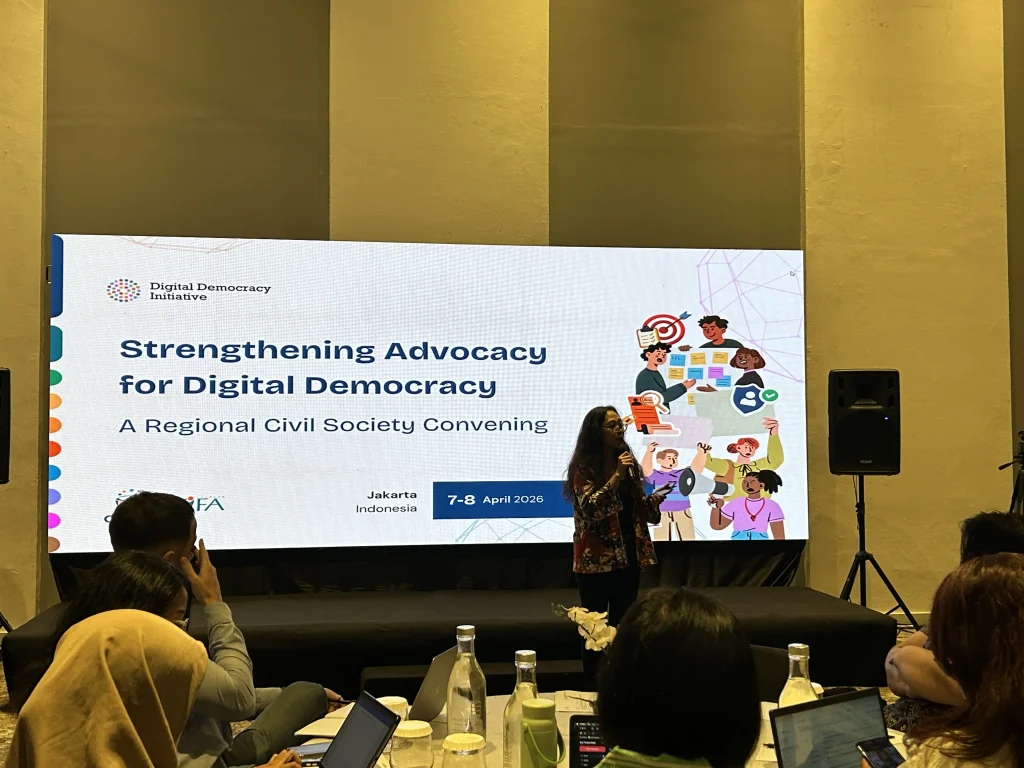
In early April 2026, twenty-five civil society representatives from ten countries across East and Southeast Asia gathered in Jakarta for a two-day convening on digital democracy. Organized under the Digital Democracy Initiative (DDI), the meeting brought together organizations working to protect civic space and strengthen democratic participation through digital technologies at a time when both are under increasing pressure across the region. It came at a critical moment where across the region, the space for civil society action is shrinking, and the organizations best placed to push back are facing some of their worst funding conditions in years.
The convening brought together participants from Cambodia, Timor-Leste, Taiwan, Indonesia, India, Myanmar, Thailand, Malaysia, Singapore, and the Philippines, representing a range of sectors, including human rights, digital rights, freedom of expression, Indigenous rights, LGBTQIA+ rights, and media freedom. It aims to build a shared understanding of the pressures facing civil society, identify advocacy priorities for 2026, and produce practical roadmaps that partners could act on.

A region facing growing repression
The urgency of the convening reflected broader regional trends. According to the CIVICUS Monitor’s People Power Under Attack 2025 report, more than 85 percent of the population in the Asia-Pacific region lives in countries rated as ‘Repressed’ or ‘Closed’ for civic freedoms. Among the countries represented at the convening, only Taiwan holds an ‘Open’ rating, while most others fall into the ‘Repressed’ or ‘Obstructed’ categories, meaning civil society operates under consistent risk of harassment, legal persecution, or outright suppression.
Participants described a region where governments are openly learning from each other’s repressive tactics. Laws criminalizing VPN use, mandatory social media identification requirements, and cybersecurity targeting activists rather than protecting them are spreading across borders. Legitimate public concerns, such as child protection or online fraud, are regularly used to justify restrictions on free expression and civic organizing. Several participants also noted that repression no longer stops at national borders. Activists who relocate for safety often remain vulnerable due to growing cooperation between governments in the region.
“ASEAN moves slowly, but it is moving. Your role is to push from the ground, build alliances across countries, and keep engaging, even when it feels difficult. Because change is not impossible. It just requires persistence and strategy,” said Anita Wahid, Indonesia Representative to the ASEAN Intergovernmental Commission on Human Rights (AICHR).
Discussions on regional digital policy highlighted additional concerns. Participants pointed to the UN Cybercrime Convention (UNCC), adopted in late 2024, which uses definitions of cybercrime so broad that they could be used to target legitimate civil society work, and its surveillance provisions often operate without judicial oversight.
The Pall Mall Process, an international initiative on spyware accountability initiative entering implementation in June 2026, was identified as another key advocacy opportunity. However, participants noted that engagement from Asian governments remains minimal. Meanwhile, platform regulation across the region continues to prioritize government content removal requests over broader accountability for harms experienced by users.
Funding cuts deepen the crisis
Alongside shrinking civic space, participants identified worsening funding conditions as another major threat facing civil society organizations. Drawing on data from Forus International, a global network representing over 24,000 civil society organizations, participants heard that 7 out of 10 organizations worldwide had been directly affected by the US funding freeze, with budget cuts ranging from 25 to 75 per cent.
The impacts across Southeast Asia have already been significant. Participants cited program disruptions and salary cuts in Indonesia, weakened advocacy coalitions in Malaysia, and Cambodia’s heavy reliance on foreign assistance, from which approximately 95 per cent of civil society funding originates.
Participants were clear that this is not a temporary disruption. Funding cuts, shrinking civic space, and growing digital repression are converging at the same time. Donors are increasingly routing money through governments instead of civil society. Organizations are being pushed to develop expertise in artificial intelligence while urgent human rights work goes under-resourced.
In response, discussions turned to practical alternatives, including resource-sharing between organizations, more strategic engagement with private-sector funders, and partnership models that avoid placing smaller organizations in dependent relationships with larger intermediary groups.
Building regional advocacy roadmaps
Participants collectively produced three regional advocacy plans. The first targets cybercrime laws across the region and demands the inclusion of human rights standards in the said laws, and the UNCC, aiming to push states for the delay or decline the signing of the convention. The second addresses the protection of human rights defenders as a whole: physical safety, digital security, legal support, and mental health, treated as connected rather than separate needs. The third takes on the funding environment directly, urging donors to shift toward more flexible, long-term support for digital rights work and calling for policies that allow civil society to receive and manage funding without undue interference.
Each roadmap names specific targets, timelines, entry points, and the organizations that will take the lead. Participants also identified key risks to implementation, including shrinking budgets, political instability, shifting donor priorities, and long-term burnout among activists and civil society workers.
Beyond Jakarta
Participants emphasized that the Jakarta convening marked the beginning of a longer regional process rather than a standalone event. In the weeks and months ahead, the participating organizations will refine their advocacy plans and begin implementation, drawing on the shared analysis and commitments built across the two days in Jakarta. A follow-up review convening is planned for November 2026 to assess progress and strengthen coordination.
“Just listening to the different contexts of digital rights and different positions of organizations is a lot of learning. Taking all of that and putting it into a cohesive strategy we can all work on is the start of something we can pursue together,” reflects one of the participants, a digital activist from Indonesia.

Calling for Proposal
We are pleased to announce that Re-D Fund Cohort 2: Reimagining Futures for Digital Democracy is now accepting applications.
The Re-D Fund provides grants to civil society organisations, collectives, and networks working to strengthen digital democracy, expand civic space, and build organisational resilience across East and Southeast Asia.
Apply before 5 June 2026.