
A Look at the 2024 Journalist Safety Index
When an explosion occurs, people run away. But at that very moment, a journalist runs toward it. They carry cameras or recording equipment, document those decisive moments, and bring the news to the public. They are neither security personnel nor medical workers. But they are the guardians of facts, the seekers of truth, and the witnesses to history. Unfortunately, their fate is increasingly hanging by a thread.
First Place in the PhD Students & Active Faculty Category:
2024 Journalist Safety Index Analysis Article Competition:
Author: Doan Widhiandono, Lecturer in the Communication Studies Program, Faculty of Social and Political Sciences, 17 Agustus 1945 University, Surabaya
Late September 2024 was an unforgettable moment for Mech Dara, a veteran Cambodian journalist. Toward the end of that month, Mech Dara was suddenly surrounded by six military police vehicles. He was arrested at a toll gate in Koh Kong province.
Mech Dara was finally put on trial. The charges against him were inciting a riot and disturbing the peace. Mech Dara, a journalist who frequently wrote investigative reports on human trafficking and corruption, was eventually imprisoned.
Two months later, in November 2024, Mech Dara was released. But he was no longer the same person. Agence France-Presse reported on March 18, 2025, that Mech Dara was terrified. Mech Dara had lost his courage. He was terrified—afraid that his life could be taken at any moment.
That same month, Mech Dara made an important announcement: he was quitting journalism. Better to lose his job than his life.
That scenario did indeed unfold in Cambodia. However, its horror has also reached Indonesia—especially given the increasingly precarious situation facing journalists. Yet these journalists are carrying out a task of such vital importance.
It is no wonder that the journalism profession in Indonesia finds itself in a dire situation: low pay, high pressure, and real threats to safety. On the one hand, the public needs fast and accurate information. But on the other hand, the journalists who provide it live in a state of economic and social insecurity. This irony is not only painful, but also jeopardizes the future of press freedom in this country.
Low Wages, a Flawed System
It is no secret that many journalists in Indonesia, especially in regional areas, are paid less than the Regional Minimum Wage (UMR). At some local media outlets, a journalist may be paid as little as 25,000 to 50,000 rupiah per story. Under freelance or contributor contracts, journalists do not receive a fixed salary, benefits, or even health and workplace safety coverage.
The 2024 Journalist Safety Index (IKJ) report by the Tifa Foundation and Populix also notes that media companies’ cost-cutting measures often have a direct impact on the erosion of journalists’ rights. Cases of unilateral pay cuts have even occurred at national media outlets. And when journalists form unions to defend themselves, they are instead laid off. This is referred to as a form of union busting.
To make matters worse, public broadcasting institutions such as TVRI and RRI have laid off more than 1,000 non-civil servant contributors and journalists across various regions due to government budget cuts. Cost-cutting measures have led to layoffs, and journalists have been the first to bear the brunt.
High Risk, Low Protection
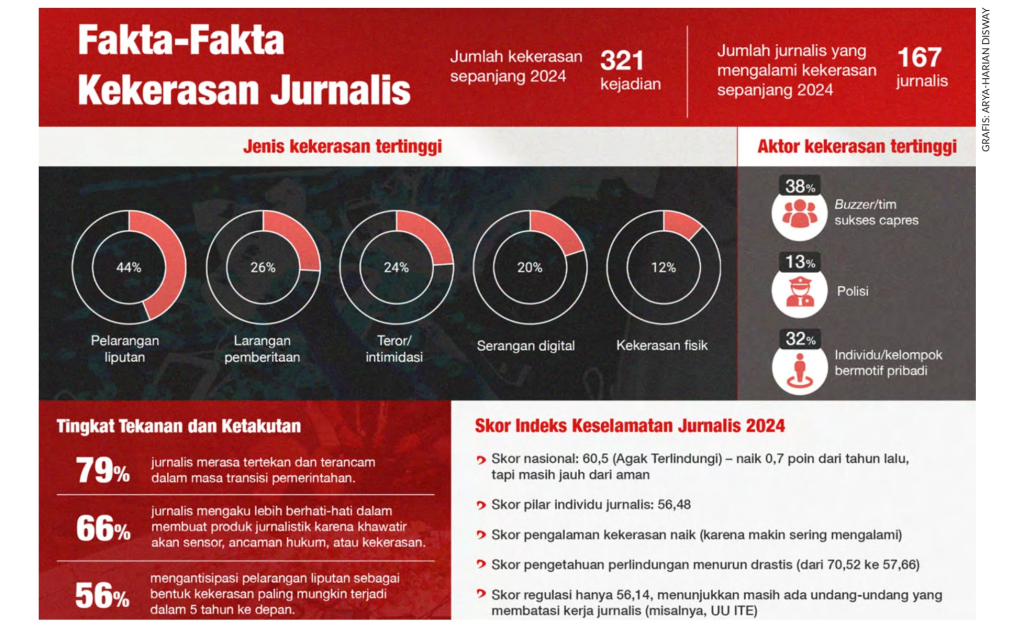
Being a journalist means being prepared to face various risks. The 2024 IKJ report notes that 167 journalists were victims of violence, with 321 incidents reported throughout the year (see chart). Restrictions on access to the scene (44 percent) and bans on reporting (26 percent) were the most common forms of violence experienced.
The perpetrators of violence are not just anyone. Political influencers and the campaign teams of presidential candidates account for the largest share (38 percent), followed by groups with personal motives (32 percent) and law enforcement officials (13 percent).
Ironically, the score for the regulatory pillar in the index was only 56.14, indicating that there are still many regulations that restrict press freedom, including vague provisions in the Electronic Information and Transactions Law. In some cases, such as that of journalist Diananta Putera Sumedi, editor-in-chief of Banjarhits, journalists have been prosecuted simply for covering sensitive issues.
Between Idealism and Structural Traps
The low pay and high risks faced by journalists are not merely the fault of individuals or companies, but a form of structural violence. The IKJ report notes that the overall index score is only 60.5 out of 100, placing journalists’ safety conditions at the “somewhat protected” level. This means that these conditions cannot yet be considered safe.
Even more surprising is that 56 percent of journalists admitted to self-censoring the news they write. The reason is that they fear legal consequences or violence. In fact, 66 percent of journalists have become more cautious in their reporting during the government transition.
Amid journalism’s shift to the digital realm, journalists face pressure not only in the field but also in cyberspace. A recent academic study reveals that journalists’ active presence on social media—which was originally intended to bring them closer to the public—has instead opened up new avenues for attacks, harassment, and hate speech.
“Rather than empowering journalists, social media often imposes additional burdens, fosters insularity, and exposes them to harassment,” write Simón Peña-Fernández et al. in a journal article titled “Shooting the Messenger? Harassment and Hate Speech Directed at Journalists on Social Media.” The study, published by the journal Societies in 2025, analyzed 60,000 responses to Spanish journalists’ accounts during the national election (2025).
Such attacks, especially those with a political agenda, do more than just take a toll on mental health. Ultimately, they can push journalists to self-censor in order to avoid conflict.
The gender dimension exacerbates this vulnerability, particularly for female journalists. Although the number of attacks against men and women is relatively equal in general categories such as insults or political hatred, the figures change significantly when the focus shifts to identity-based hate speech.
“Sexist messages were received to a much greater extent by women and were sent significantly more often by users with extremist or right-wing populist views,” the report states. This indicates that in an increasingly polarized political climate, female journalists face a double burden: they are targeted both as media workers and as women. This situation reflects that violence against journalists is not merely an attack on individuals, but a systematic effort to silence voices critical of those in power.
Time for Change: Protecting Those Who Protect Democracy
It is time for the media, the government, and the public to realize that journalists are not merely “news presenters,” but guardians of democracy. They are the eyes and ears of the public, working in difficult conditions to ensure that those in power do not operate without oversight.
Therefore, the 2024 IKJ report emphasizes that the protection of journalists must be a collective effort. The government must revise regulations that threaten press freedom; media companies must provide safety protocols and security training; and civil society must strengthen labor unions and advocacy efforts.
The majority of journalists (90 percent) even emphasize the importance of labor unions in the media industry. However, only 43 percent are currently union members. This means there is still a long way to go in building collective protection from the ground up.
It must be acknowledged that being a journalist in Indonesia is a high-risk, low-paying, and high-pressure job. Yet it is precisely through their efforts that democracy is upheld, the people’s voices are heard, and the truth is revealed. This irony must come to an end.
After all, if journalists continue to be treated like disposable heroes, who will speak up for the truth?
Healthy journalism can only thrive in a healthy system—one that truly values journalists, not one that exploits their idealism. Let’s not allow journalists to continue walking alone in the dark, carrying the truth on frail shoulders and surviving on meager wages.
Read the 2024 Journalists' Safety Index here.
This article is a repost of the following original article. Permission to repost is stipulated in the rules and has been approved by each contest participant.
Safe Journalism (JA) is a consortium comprising the Tifa Foundation, the Human Rights Working Group (HRWG), and the Indonesian Media Development Association (PPMN), supported by the Dutch Embassy. JA works to create a safe ecosystem for journalists—ensuring press freedom in Indonesia.
The Safe Journalism Roadshow was held to advocate for—and publicize—the activities and publications that have been carried out among student press organizations in Western, Central, and Eastern Indonesia, including the integrated reporting and learning platform, JurnalismeAman.com.