

Khant Khant Zar Nyi
Project Officer for the Digital Democracy Initiative project at Tifa Foundation,
Lead of the Young Tech Collective for Change (YTC)
Embedding Capacity, Sustaining Practice: DRAPAC 2026 and the Case for YTC's Focal Point Model
This article is part of the DDI at DRAPAC 2026 series.
DRAPAC 2026 unfolded just weeks after Tifa Foundation closed its five-day on-site training for the Young Tech Collective for Change (YTC) in Kuala Lumpur. YTC is Tifa Foundation’s non-financial support mechanism, implemented in partnership with the Digital Defenders Partnership under the Digital Democracy Initiative, running across 14 Host Organizations in East and Southeast Asia. Joining the sessions to reflect on YTC’s work, three key insights stood out and continue to shape how to proceed with the next accompaniment ahead: what digital security trainers in Southeast Asia are struggling with, what community members and activists are struggling with, and what the shrinking funding landscape means for both.
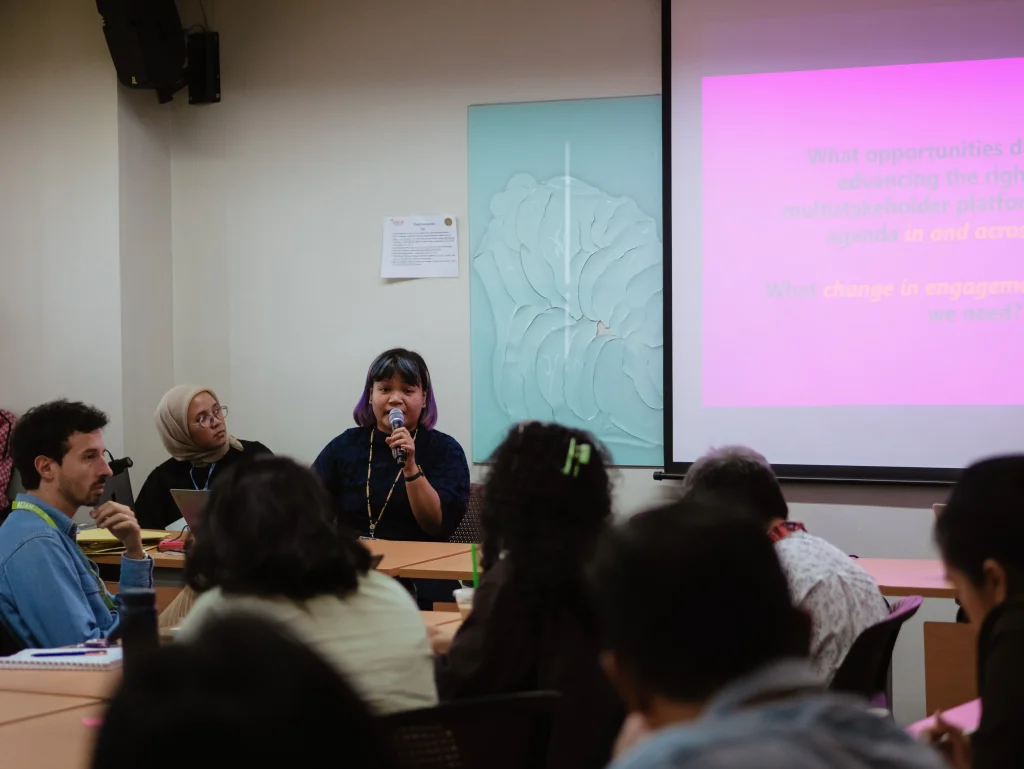
Two sessions carried most of this learning. The first was “From Risk to Resilience: Bringing Communities and Trainers Together for Digital Safety”. Rather than a panel, participants were split into two groups: trainers and incident responders in one, community members and activists in the other, and they were asked to speak candidly about what is not working in the current model of digital safety.
The trainer community in Southeast Asia is small and getting smaller. Participants observed that the same practitioners circulate through every regional convening, and few new people are entering the field. Many are freelance without institutional support and with limited access to psychosocial support despite the emotional weight of the work. Threats, meanwhile, are becoming layered and hybrid, such as online surveillance combined with physical intimidation, data leaks paired with coordinated harassment, and platform-level violations reinforced by state campaigns. Trainers said clearly that they are keeping pace with the threats themselves. What is failing them is the surrounding infrastructure of short project cycles, restrictive legal environments, and donor expectations of quick, measurable outcomes on work that takes years to embed.
They also mentioned that tools and trainings on offer can feel overwhelming or disconnected from participants lived realities. People sit through workshops and rarely translate the content into practice. After a strong week of YTC onsite training in Kuala Lumpur, small moments surfaced that reminded us that awareness does not automatically translate into behavior. For the YTC accompaniment, the design challenge is creating space for Focal Points to practice, question, and internalize, rather than only revisiting what was already said.
The second group told a different story. Representing many activists and community members in the region, they mentioned that digital security is not the primary struggle in real-world situations. Rather, it is basic digital literacy, such as the ability to use online services safely every day. Participants from the Philippines described the rapid digitalization of government and social services without a matching investment in helping people navigate these platforms. Before communities can be protected from advanced threats, many still need support to open an account, verify an identity, or recognize a phishing message. They also spoke about the hidden cost of security in resource-scarce environments: safety practices demand time, cognitive space, and emotional energy, resources that are already stretched thin for people managing physical risk, economic precarity, or displacement.
Despite their different vantage points, both groups agreed that digital security has to be integrated into the ongoing work of activists, labor organizers, women's rights defenders, grassroots communities, and so on.
Khant Khant Zar Nyi
Despite their different vantage points, both groups agreed that digital security has to be integrated into the ongoing work of activists, labor organizers, women’s rights defenders, grassroots communities, and so on. A notable quote from the session is “The security landscape as a whole is rather broken, but I hope it’s not beyond repair.” For YTC, this is precisely why the Focal Point model matters. The accompaniment is designed to build lasting capacity inside Host Organizations so that Focal Points can sustain the work independently once the program closes.
The second session, Resourcing Digital Rights Advocacy in Southeast Asia, was co-organized by Tifa Foundation and partners. It gave the funding side of the same story. Across the discussion, a shared reality emerged: civil society organizations working on digital rights in the region are navigating shrinking, less predictable, and more politically constrained funding, and are searching for ways to hold their work steady while traditional grant pipelines contract. When civil society organizations contract, other actors (some corporations, some state-aligned, some openly hostile to rights) expand into the space they leave behind. This is where YTC’s design becomes meaningful. As a non-financial support mechanism, YTC is not a substitute for the direct funding these organizations continue to need, but it offers something complementary: capacity, accompaniment, and connection. These are more resilient to sudden funding shocks, and they help Host Organizations sustain their people and their work even in constrained environments.
Sitting with these conversations, a few implications become clear for YTC. The program responds directly to both problems raised at DRAPAC. By investing in Focal Points inside Host Organizations, it gradually widens the pool of people carrying digital safety forward, and because the support is non-financial, it is also less exposed to the sudden funding shocks that shape so much of this work. YTC must also design deliberately for the appreciation gap between awareness and practice. Strong training content is not enough on its own, and the accompaniment will need scenario walk-throughs, reflective check-ins, and honest spaces to surface challenges without punishment. Just as importantly, YTC does not stand outside the fragile ecosystem it supports. Several Host Organizations are themselves operating with reduced teams and constrained budgets, which means the accompaniment must listen for ecosystem signals such as funding shifts, legal changes, and staff turnover that shape whether a Focal Point can sustain the work back inside their organization.
DRAPAC 2026 was, in that sense, a reminder that the Digital Protection Accompaniment Model is not just a design choice. It is a direct response to what trainers, communities, and funders across the region are already telling us.