
Press Release: 2025 Journalist Safety Index Declines; 67% of Journalists Have Experienced Violence
The issues most frequently subject to self-censorship are coverage of the Free Nutritious Meals (MBG) program and National Strategic Projects (PSN), each cited by over 50 percent of respondents. Meanwhile, the state and regulation pillar was the only one to record an increase in scores, driven by journalists’ improved perceptions of the roles of regulation and law enforcement. Nevertheless, the ITE Law is still perceived as the regulation most likely to threaten journalists’ freedom.

Jakarta, February 10, 2026 – The 2025 Journalist Safety Index (JSI) score has declined compared to the previous year. Research results show that the 2025 JSI stands at 59.5 out of 100, placing it in the “Somewhat Protected” category . Although it remains in the same category as in 2023 and 2024, the score has decreased by approximately 0.9–1 point compared to the previous year.
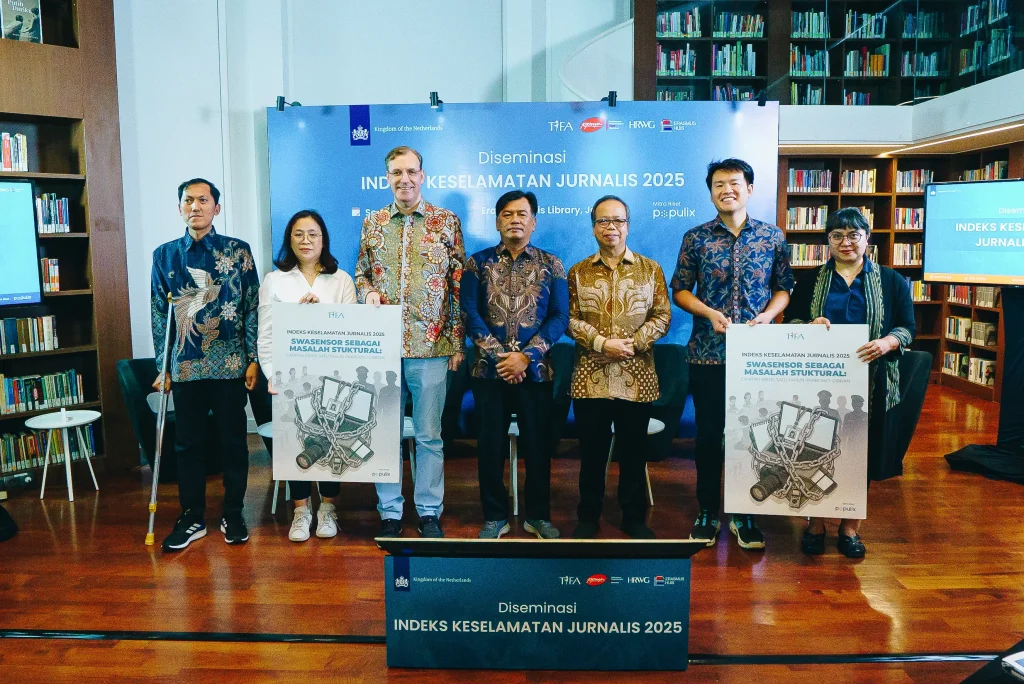
This was revealed at the launch of the IKJ 2025, organized by the Tifa Foundation in collaboration with the Safe Journalism Consortium and Populix. The index is expected to serve as an evidence-based data source to prevent violence against journalists while promoting safer and more dignified working conditions.
Oslan Purba, Executive Director of the Tifa Foundation, explained that the IKJ has been produced consistently every year and is now in its third year. This index serves as an important evaluation tool for assessing the state of press freedom and the safety of journalists in Indonesia, as well as a reference for stakeholders in formulating policy.
“This index is important for ensuring that journalists can work safely, so that the public’s right to information can be fulfilled,” said Oslan at Erasmus Huis on Monday, February 9, 2026.
During the session presenting the research findings, Populix’s Policy and Society Research Manager, Nazmi Tamara, explained that the IKJ 2025 survey was conducted among 655 active journalists across 38 provinces in Indonesia and took place from November to December 2025. Additionally, this research also utilized secondary data on incidents of violence against journalists compiled by the Alliance of Independent Journalists (AJI).
Populix conductedin-depth interviews with journalists who have experienced violence, as well as various stakeholders in the field of journalism, to gather firsthand accounts from the field and enrich the data analysis.
“Here, we want to examine the challenges faced by journalists—whether from the individual’s perspective, the media companies that employ them, or external stakeholders , including regulatory bodies and government agencies,” said Nazmi.
The most significant decline was recorded in the categories of individual journalists and media stakeholders . Among individuals, the incidence of violence experienced by journalists rose sharply. A total of 67% of respondents reported having experienced violence, a significant increase compared to 2024, when the figure was around 40 percent. The most prevalent forms of violence were bans on reporting and coverage, while physical violence and direct threats tended to decrease.
On the other hand, although incidents of violence have increased, journalists’ awareness of risks and prevention efforts has actually risen by about 20 points, indicating a growing awareness among journalists of safety threats.
Another key finding is the rise in censorship and self-censorship. A Populix survey found that 72% of journalists reported having experienced censorship, while 80% of respondents stated they had engaged in self-censorship. These practices occur across media platforms and roles, ranging from journalists and editors to editorial directors. The primary reasons for self-censorship include avoiding excessive conflict and controversy, protecting personal safety, and responding to pressure from certain parties.

The issues most frequently subject to self-censorship are coverage of the Free Nutritious Meals (MBG) program and National Strategic Projects (PSN), each cited by over 50 percent of respondents. Meanwhile, the state and regulation pillar was the only one to record an increase in scores, driven by journalists’ improved perceptions of the roles of regulation and law enforcement. Nevertheless, the ITE Law is still perceived as the regulation most likely to threaten journalists’ freedom.
From a field perspective, Tempo journalist Francisca Christy Rosana highlights the shifting nature of threats against journalists, which now include not only physical violence, hacking, and doxing, but also restrictions on access to information. When covering strategic issues such as the MBG and PSN, journalists often struggle to find sources because structural pressures make many officials reluctant to speak openly and on the record.
“This situation signals a deterioration in the climate of free speech and has an impact on the public’s right to access information,” he said.
Arie Mega, Safe Journalism Project Officer at the Tifa Foundation, added that this shift in the nature of threats has formed the basis of the Safe Journalism Consortium’s work from 2022 to the present. Through a research-based approach, the consortium has conducted in-depth mapping in regions with high levels of violence, such as Aceh, Palu, and Sorong, while also strengthening journalists’ capacity through safety and protection training.
“We found that many journalists, especially female journalists, are in a highly vulnerable position and often lack a safe space to speak out. For this reason, Safe Journalism focuses not only on responding to individual cases but also on building a sustainable protection ecosystem,” said Arie.
Abdul Manan, a member of the Press Council, hopes that the findings of this index will serve as a reference for the government and all stakeholders to strengthen legal protections for journalists, prevent violence and criminalization, and ensure that no issue is off-limits in journalistic practice.
“If censorship and repression are allowed to continue, it is the public that will suffer the most by losing their right to information,” said Manan.
Nursodik Gunarjo, Director of Public Information at the Indonesian Ministry of Communication and Digital Affairs, considers this research to be strategic because it reflects press freedom and the quality of democracy. The government is committed to strengthening protections for journalists through regulatory improvements, cross-sector collaboration, and the development of regulations to protect journalistic works from unauthorized use of AI.
“This index is very important to all of us, because it is not merely a number; it reflects the state of press freedom and, more broadly, the quality of our democracy,” said Nursodik.
The Safe Journalism Consortium consists of the Tifa Foundation, the Indonesian Media Development Association (PPMN), and the Human Rights Working Group (HRWG), and is supported by the Embassy of the Kingdom of the Netherlands in Indonesia. Chargé d’Affaires Adriaan Palm emphasized that the safety of journalists is a vital foundation for a healthy democracy.
“When journalists can work freely and safely, the public will have access to reliable information, and trust will be built between the people and the state,” said Adriaan.
To view the full“2025 Journalist Safety Index”report, please visit www.tifafoundation.id/IndeksKJ-2025.
About Safe Journalism
Safe Journalism is a program initiated by three nonprofit organizations: the Tifa Foundation, the Human Rights Watch Group (HRWG), and the Association for the Development of Indonesian Media (PPMN). The program aims to promote the safety of journalists in Indonesia, with the goal of creating a safe and enabling ecosystem for journalists to advance press freedom and ensure an independent media. This consortium of three organizations identifies a major issue that is increasingly restricting the press and journalists: the lack of systematic mechanisms to protect the work of professional journalists and citizen journalists.
About Populix
Populix is a technology-driven research company that connects businesses, institutions, and individuals with high-quality, diverse, and targeted respondents across Indonesia. With a data-driven approach and cutting-edge technology, Populix provides end-to-end research solutions—from planning, data collection, and analysis to reporting—for market research as well as public and social policy studies. In addition to custom research services, Populix has developed an online self-service survey platform to help users access insights quickly and efficiently. To download the latest studies from Populix, please visit info.populix.co.
For more information, please contact:
| Patricia Saputra Marketing & PR, Populix [email protected] |
Arie Mega Project Officer for Safe Journalism, Tifa Foundation [email protected] |