
[Press Release] 2025 Journalist Safety Index: The Rise of Self-Censorship Gives Rise to “New Taboos” in Journalism
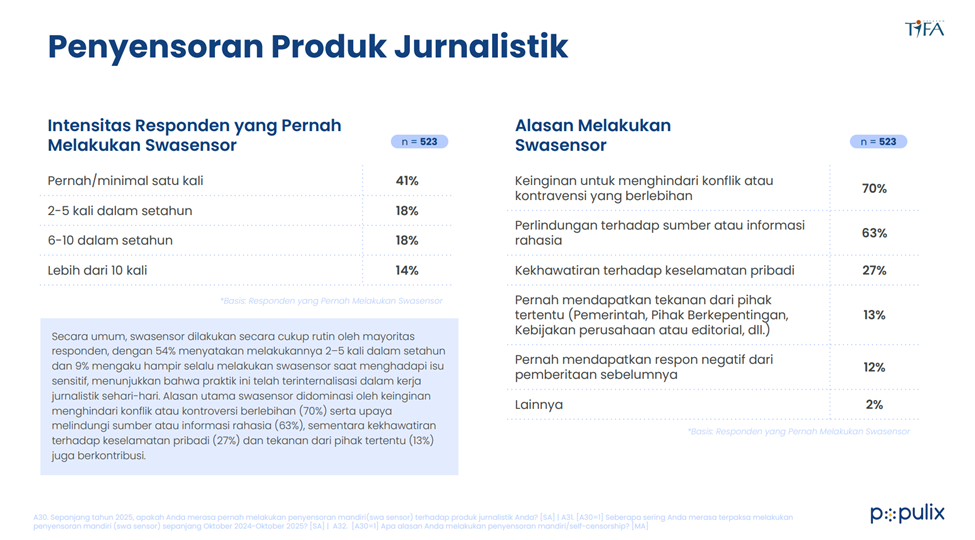
This report also notes that self-censorship is most often driven by concerns about legal repercussions and personal safety, including the potential for complaints filed under regulations such as the ITE Law. Most respondents stated that the decision to self-censor was not solely a personal initiative, but was influenced by editorial and media management considerations. These findings indicate that self-censorship has become a structural practice within newsrooms, rather than merely an individual decision by journalists.
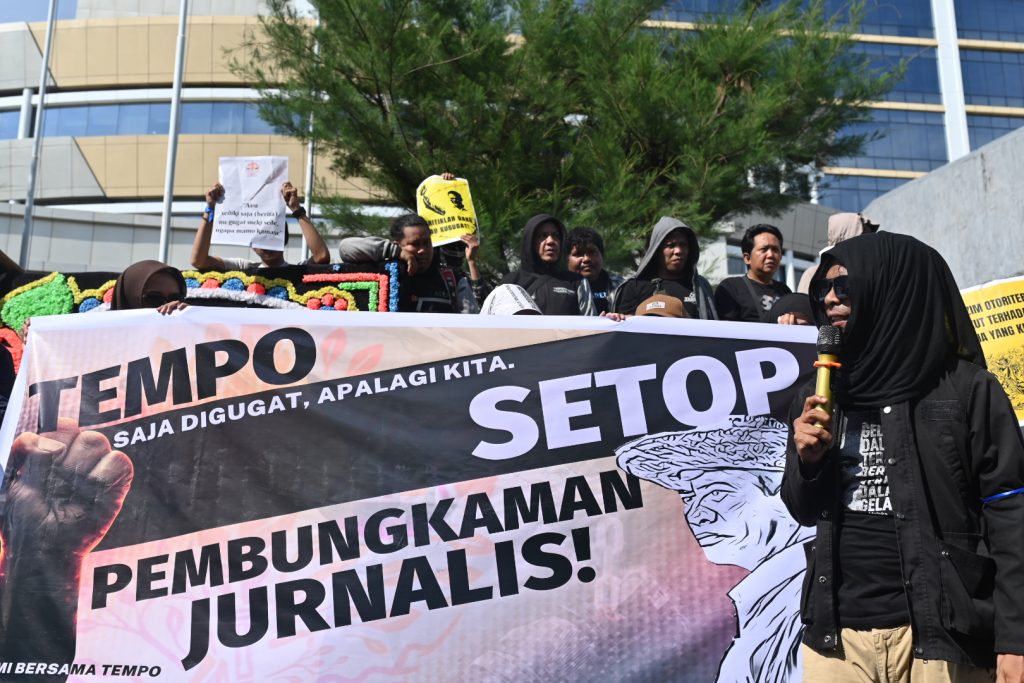
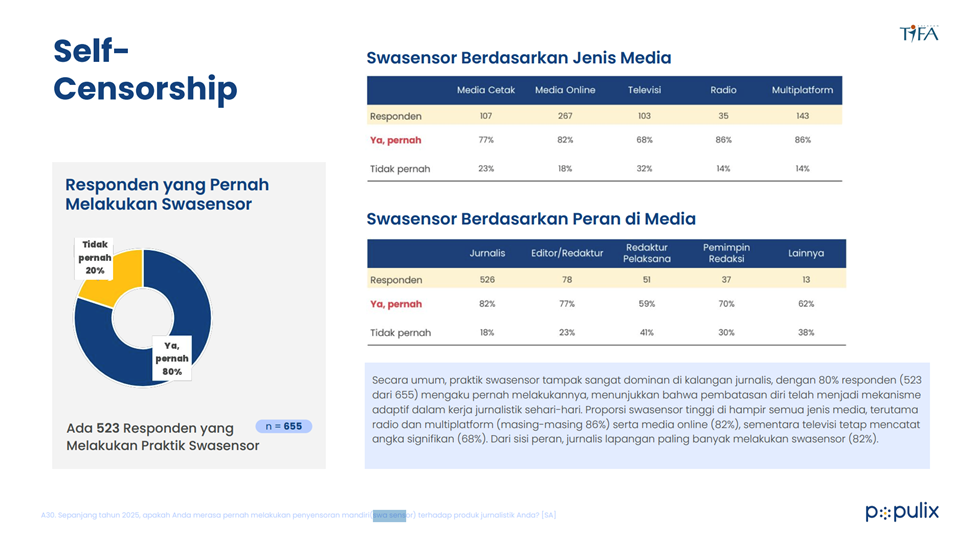
Jakarta, February 12, 2026 – The 2025 Journalist Safety Index (IKJ) notes a growing trend of self-censorship among Indonesian journalists. A total of 80% of journalists admitted to having practiced self-censorship, while 72% of respondents stated they had experienced censorship. This phenomenon has given rise to what is referred to as a “new taboo” in journalistic practice—namely, certain issues that tend to be avoided or restricted in news coverage.
These findings are discussed in the 2025 Journalist Safety Index (IKJ) report, jointly compiled by the Tifa Foundation, the Safe Journalism Consortium, and Populix. The report, which has been published annually over the past three years, indicates that the trend of self-censorship is on the rise, even leading to the emergence of certain news topics that journalists tend to avoid.
Research shows that self-censorship occurs across platforms and at all levels, from reporters and editors to editors-in-chief. The main reasons are to avoid excessive conflict and controversy, protect personal safety, and respond to pressure from certain parties. The issues most frequently subject to self-censorship are coverage of the Free Nutritious Meals (MBG) program (58%) and National Strategic Projects (52%).
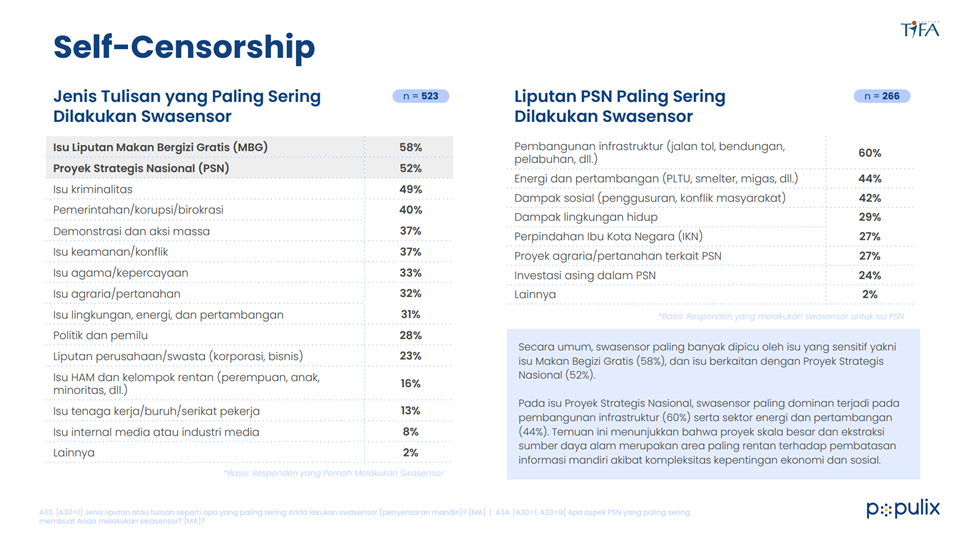
This report also notes that self-censorship is most often driven by concerns about legal repercussions and personal safety, including the potential for complaints filed under regulations such as the ITE Law. Most respondents stated that the decision to self-censor was not solely a personal initiative, but was influenced by editorial and media management considerations. These findings indicate that self-censorship has become a structural practice within newsrooms, rather than merely an individual decision by journalists.
Arie Mega, Safe Journalism Project Officer at the Tifa Foundation, noted during the launch of the IKJ on Monday (February 9, 2026) that there has been a shift in the nature of threats against journalism. Whereas violence was previously synonymous with intimidation or physical attacks in the field, pressure now takes a more structural form—extending into media offices, newsrooms, and even to the level of media owners—and ultimately leads to self-censorship. “Many journalists self-censor not because they fail to understand which issues are important to the public, but because they are trying to survive within a repressive system,” she said.
IKJ Research Expert Abdul Manan, in the introduction to the IKJ 2025 report, also views self-censorship as a narrowing of editorial freedom and refers to it as the emergence of “new taboos.” According to him, this phenomenon is serious because certain issues are no longer formally banned, but are avoided in practice due to the risk of political, economic, or legal pressure. This situation is considered more dangerous because it operates covertly through fear and uncertainty, causing journalists to self-censor before pressure actually materializes.
From a field perspective, Tempo journalist Francisca Christy Rosana noted that it is not only journalists who are hesitant to speak more freely, but sources are also reluctant to open up about sensitive issues. “In addition to physical violence and hacking, restrictions on access to information pose a serious challenge, especially when covering strategic issues such as MBG and PSN. Many sources are reluctant to speak openly and on the record due to structural pressures,” she said.
“For us, self-censorship isn’t just a matter of editorial ethics. It’s a matter of democracy,” said Arie Mega. When journalists are forced to censor themselves, it’s not just media independence that suffers, but also the public’s right to receive complete information.
He added that when comparing the IKJ indicators year over year, significant fluctuations are evident. Some indicators showed improvement at one point but declined again in the following period, including the practice of self-censorship among journalists. This pattern suggests that the improvements observed are still temporary and do not yet reflect systemic change. “This reinforces the conclusion that the foundation of our journalists’ protection is not yet solid,” he said. In this context, Safe Journalism is working to build a stronger protection ecosystem so that journalists can carry out their duties without fear.
The Safe Journalism Consortium—comprising the Tifa Foundation, the Association for the Development of Indonesian Media (PPMN), and the Human Rights Working Group (HRWG)—emphasizes that this shift in the nature of threats requires a more systematic and sustainable approach to protection. Support for journalists’ safety is key to ensuring that no issue becomes taboo in journalistic practice.
The 2025 IKJ Survey was conducted among 655 active journalists in 38 provinces from November to December 2025. In addition to the quantitative survey, the research also included in-depth interviews and secondary data on violence against journalists. A total of 67% of respondents reported having experienced violence, a significant increase from approximately 40% in 2024. The most prevalent forms of violence were bans on reporting and bans on coverage. To view the full “2025 Journalist Safety Index” report, please visit www.tifafoundation.id/IndeksKJ-2025.
About Safe Journalism
Safe Journalism is a program initiated by three nonprofit organizations: the Tifa Foundation, the Human Rights Watch Group (HRWG), and the Association for the Development of Indonesian Media (PPMN). The program aims to promote the safety of journalists in Indonesia, with the goal of creating a safe and enabling ecosystem for journalists to advance press freedom and ensure an independent media. This consortium of three organizations identifies a major issue that is increasingly restricting the press and journalists: the lack of systematic mechanisms to protect the work of professional journalists and citizen journalists.
About Populix
Populix is a technology-driven research company that connects businesses, institutions, and individuals with high-quality, diverse, and targeted respondents across Indonesia. With a data-driven approach and cutting-edge technology, Populix provides end-to-end research solutions—from planning, data collection, and analysis to reporting—for market research as well as public and social policy studies. In addition to custom research services, Populix has developed an online self-service survey platform to help users access insights quickly and efficiently. To download the latest studies from Populix, please visit info.populix.co.
For more information, please contact:
| Patricia Saputra Marketing & PR, Populix [email protected] |
Arie Mega Project Officer for Safe Journalism, Tifa Foundation [email protected] |