
A Critical Analysis of the 2024 Journalist Safety Index Data
In fact, aside from violence, the threat to press freedom lurks in a more subtle way: through fear.
Winner of the 2024 Journalist Safety Index Analysis Article Contest
Author: Nada Azka Maulida, Philosophy Student at the University of Indonesia
They thought a press pass would protect them—until one day, they were choked by security forces in Poco Leok, their cell phones were smashed in front of the House of Representatives building, and the bodies of their colleagues were burned to ashes along with their families. A report titled the 2024 Journalist Safety Index: Threats and Risks to Journalist Safety During the Transition Period, published by the Tifa Foundation, gave a score of 60.5 (“somewhat protected”). But beyond the numbers, in reporting environments rife with pressure and intimidation, 167 journalists faced direct violence.
Patterns are illusions we create to reassure ourselves—or so David Hume warned. In 2025, that illusion crumbled. Nearly every demonstration is now accompanied by police batons striking journalists’ bodies, packages containing pig heads and rats suddenly appearing on Tempo’s editorial desk, and most recently—the president’s order for journalists to step aside as he prepared to deliver a state address. Given the reality currently unfolding, if read carefully, that 2024 index is in fact a tombstone prepared too soon. This is no longer a prediction, but an autopsy of a death in progress: 2024 may well be the final year before press independence is shattered and swallowed by the grim path of autocracy.
The report identifies several trends in patterns of violence against journalists in 2024. Periods of political transition are always a turning point for a nation’s democracy—whether toward a brighter future and a breath of fresh air, or conversely, a descent into the abyss of darkness. Elections, as political contests, are always marked by complex and intricate dynamics, and journalists, as watchdogs, play a crucial role in reporting on the momentum and developments within them. Unfortunately, this heavy responsibility often threatens their freedom and safety.
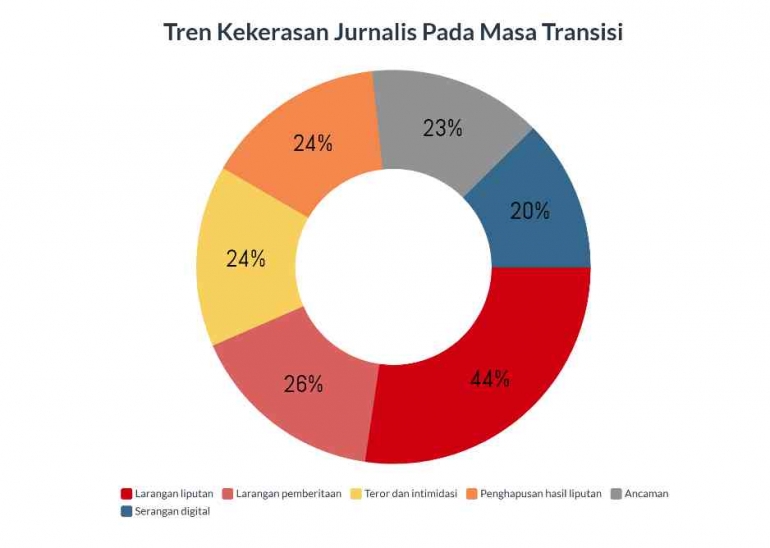
The 2024 Journalist Safety Index (IKJ) report published by the Tifa Foundation does not merely document injuries, but also reveals new patterns of violence that are subtly infiltrating society. During this transitional period, oppression is dominated not by physical blows, but by bans on reporting (44%), bans on news coverage (26%), and terror and intimidation (24%), which have now become new weapons of silencing. These findings also indicate a new trend: an increase in digital attacks in the form of hacking and doxxing, reported by 20% of respondents.
Several empirical facts support these statistics. During the 2024 regional elections, a reporter from Suara Demokrasi was barred from covering the first public debate for candidates for regent and deputy regent of Sumenep, which was organized by the Sumenep General Election Commission (KPU) in the auditorium of Bahaudin Mudhary University (Uniba). The organizing committee claimed they lacked an official invitation, even though the event was funded by taxpayer money and should have been open to the public. (SuaraDemokrasi, 2024)
The situation did not improve after the election; in fact, it was quite the opposite. Mass demonstrations during President Prabowo’s administration, including protests against the Regional Election Bill (RUU), were marred by violence against journalists at the hands of security forces. When tear gas was deployed, H, a Tempo journalist, decided to document the incident. It turned out that this action led to disaster—as soon as they saw the camera H was holding, security forces immediately surrounded him and forced him to delete the video. “… Then I was hit. The first blow came from the right. Eventually, I complied with their demand to delete the video,” H said bitterly.
True democracy does not die from a single bullet. It dies a slow death—behind editorial desks, in the lavish meeting rooms of elected officials where discussions take place behind closed doors, or on the screens of journalists’ cell phones, which are filled with terror and threats. In fact, aside from violence, the danger to press independence lurks in a more subtle way: through fear.
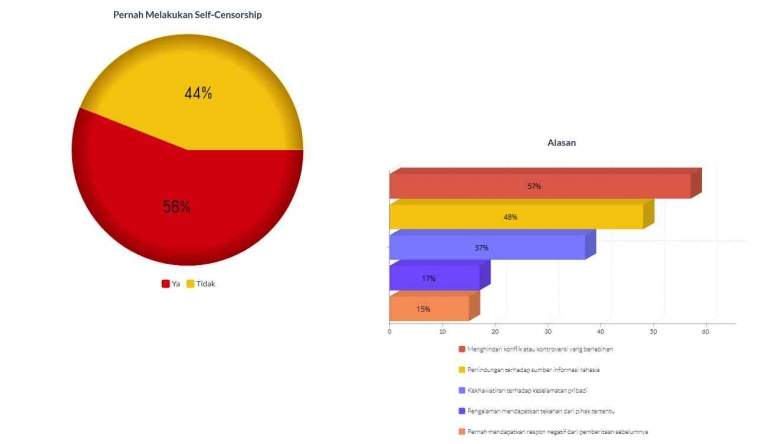
The 2024 IKJ Report reveals a high rate of self-censorship, at 56% throughout 2024. The reasons vary, but they never stray far from deeply ingrained fears: avoiding excessive conflict or controversy (57%), protecting confidential sources (48%), and concerns for personal safety (37%). Decisions to self-censor are also frequently driven by experiences of pressure (17%) and negative reactions to previous reporting (15%).
This is where the 2024 IKJ score reaches a crossroads when re-examined using the Critical Discourse Analysis (CDA) framework (Fairclough, 2013). CDA is a discourse analysis approach that examines how language is used to shape and reproduce power relations, ideologies, and domination within social contexts. The 2024 IKJ report states that the Media Stakeholders pillar has the highest score at 73.32, implying the success of media actors in creating an ecosystem that protects journalists. This pillar consists of three main actors: Media Companies, Civil Society Organizations (CSOs) such as LBH/LBH Pers, and State Institutions including the Press Council and the National Commission on Human Rights (Komnas HAM). In the report text, this score is framed through technocratic language such as “the availability of SOPs,” “safety training,” and “support from CSOs and state institutions.” These terms evoke a bureaucratic image—an idealized world where procedures and training are deemed sufficient to address the complexities of violence against journalists.
However, beneath the surface of that text, upon closer examination, there is actually a contradictory representation: the media organization itself is the most dominant actor in censorship.
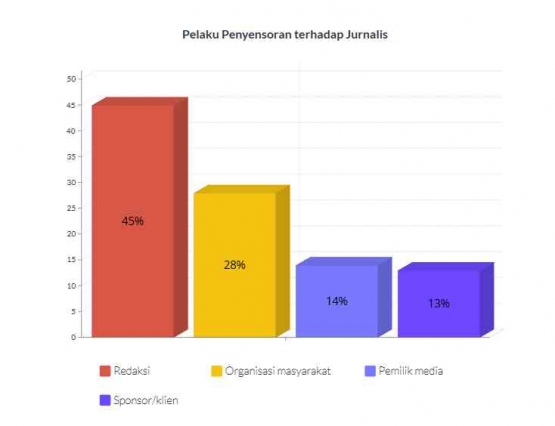
The chart above clearly shows that the primary perpetrators of censorship are not state actors or government officials, but rather the very institutions that should be defending freedom of expression: the editorial boards themselves (45%). This data underscores a reversal of power dynamics, in which the media has effectively become the enforcement arm for suppressing its own journalists. Apart from civil society organizations (28%), media owners also accounted for the third-highest number of instances of censorship (14%), followed by sponsors/clients (13%).
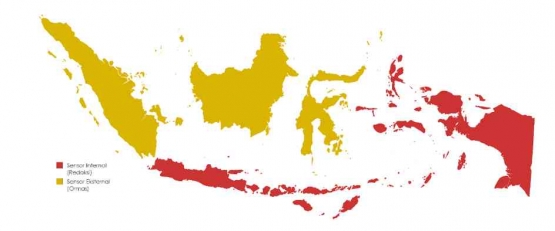
When broken down by region, it appears that journalists in Sumatra, Java, Bali-Nusa Tenggara, Maluku-North Maluku, and Papua face the most censorship from their editorial boards. This further calls into question the notion of media companies as protectors, given that, in social practice, the media are also perpetrators of censorship. Thus, there is a discursive contradiction between how the media are constructed and how they actually operate.
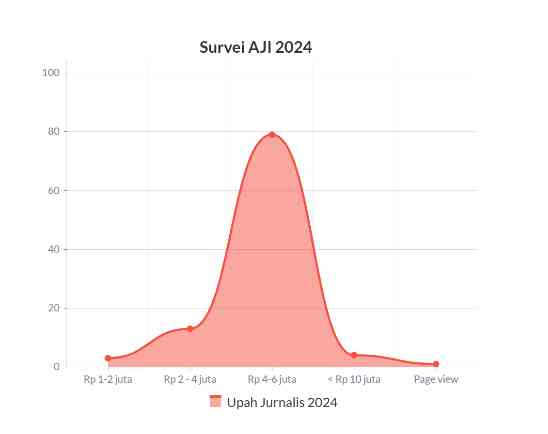
The shadow of the death of press independence does not stop at mere censorship. The threat is now creeping deeper and targeting journalists’ most basic needs—clothing, food, and a sense of security. According to the Decent Wage for Journalists survey conducted by the Jakarta Alliance of Independent Journalists (AJI), the majority of respondents have not yet reached the decent wage threshold of Rp 8,334,542. The results show that 79 percent of respondents reported earning between Rp 4 million and Rp 6 million per month, 13 percent earned between Rp 2 million and Rp 4 million per month, 4 percent earned less than Rp 10 million, 3 percent earned between Rp 1 million and Rp 2 million per month, and 1 percent were paid per page view or article reader. (AJI, 2024)
In addition to inadequate wages, the survey also revealed that 13% of respondents experienced pay cuts. This situation aligns with an actual case involving one of the major national media outlets, CNN Indonesia, which was found guilty of unilaterally cutting the wages of a number of employees. It doesn’t stop there; CNN Indonesia is also suspected of engagingin union busting. These allegations arose following the termination of employment (PHK) of the executive board of the CNN Indonesia Workers’ Union (SPCI). CNN Indonesia management is also accused of conducting an anti-union campaign in September 2024 by forcing employees in the television and online divisions to sign a statement rejecting the presence of SPCI. It’s not just CNN Indonesia; AJI stated that there are 13 media companies violating their workers’ rights, including major media outlets such as Kompas Media Nusantara (Kompas.id), MNC Group, Media Indonesia, Liputan6, Suara.com, Republika, and Tribun Group. (Trimurti, 2025) Additionally, the 2024 IKJ report also noted that media companies’ cost-cutting measures have led to a reduction in journalists’ rights, posing an additional challenge—including layoffs resulting from budget-cutting policies at public broadcasting institutions such as TVRI and RRI.
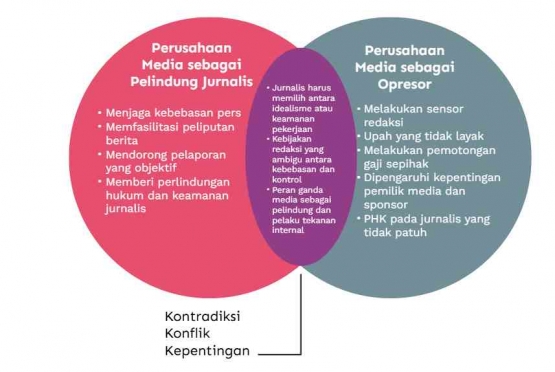
Based on the Venn diagram above, it can be seen that internal censorship that threatens press independence and violations of journalists’ rights as workers indicate a conflict of interest arising from the dual roles of media companies. Therefore, the parameters of the Media Stakeholder Pillar should be reevaluated when assessing the Journalist Safety Index, given that media companies are one of the groups included in it.
This data cannot be interpreted merely as numbers—this is where the importance of employing discourse analysis and theories of power comes into play, particularly the frameworks of biopolitics and governmentality proposed by Michel Foucault. Governmentality, or the rationality of governance, allows us to see how journalists are disciplined not only through physical violence, but through institutional mechanisms such as pressure from editors, media owners, and even safety protocols. (Foucault, 1976) The practice of self-censorship ( engaged in by 56% of journalists according to the data) is a concrete example of power operating through the internalization of fear and self-management, rather than external coercion.
Meanwhile, Foucault’s concept of biopolitics aligns with how journalists’ lives are regulated, produced, and in some cases, systematically left to “fade away”—through low wages, pay cuts, or layoffs following union formation. Power here no longer kills directly, but determines who is allowed to live with dignity, and who is left to be excluded from the system. (Senellart et al., 2009) Within this framework, we can see that violence against journalists is not merely about who the perpetrators are, but how power operates subtly—through discourse, institutions, and the management of fear—to control journalistic work within a democratic framework that appears vibrant but is, in reality, slowly decaying.
It may be too early to write an obituary, but the lines are already beginning to appear on the back pages of our media’s history. Journalistic independence is slowly dying—not always at the barrel of a gun, but through editorial pressure that creeps in as directives, censorship disguised as “business considerations and interests,” and wages that continue to be undervalued. However, Foucault also asserts: where there is power, there is resistance. Amid systemic threats, resistance must be collective. Decisive legal reforms, breaking the chain of media owners’ intervention, and ensuring a decent livelihood for journalists are key steps. Public solidarity—as critical readers—can also serve as the last line of defense when the state and media oligarchs turn a blind eye. If this report is an obituary, our struggle today is to save the remaining lives and ensure that the death of journalistic independence does not become an inevitable reality.
References
Fairclough, N. (2013). Critical Discourse Analysis: The Critical Study of Language ( 2nd ed.). Routledge. https://doi.org/10.4324/9781315834368
Senellart, M., Ewald, F., & Fontana, A. (Eds.). (2009). Security, Territory, Population. Palgrave Macmillan UK. https://doi.org/10.1057/9780230245075
Society Must Be Defended. (n.d.). Macmillan Publishers. Retrieved May 17, 2025, from https://us.macmillan.com/books/9780312422660/societymustbedefended/
AJI Survey: 85 Percent of Journalists in Jakarta Do Not Receive a Living Wage | tempo.co. (June 22, 2024). Tempo. https://www.tempo.co/ekonomi/survei-aji-85-persen-jurnalis-di-jakarta-tak-dapat-upah-layak-468 48
Trimurti. (February 4, 2025). 13 Media Companies Violated Workers’ Rights Throughout 2024. Trimurti.ID. https://trimurti.id/kabar-perlawanan/13-perusahaan-media-rampas-hak-buruh-sepanjang-2014/
Journalists Barred from Covering the First Public Debate for the 2024 Sumenep Regional Election; Is the KPU Under Scrutiny? ( 2024, October 28).
https://suarademokrasi.id/wartawan-dilarang-meliput-debat-publik-pertama-pilkada-sumenep-202 4-kpu-questioned/
Read the 2024 Journalists' Safety Index here.
This article is a repost of the following original article. Permission to repost is stipulated in the rules and has been approved by each contest participant.
Safe Journalism (JA) is a consortium comprising the Tifa Foundation, the Human Rights Working Group (HRWG), and the Indonesian Media Development Association (PPMN), supported by the Dutch Embassy. JA works to create a safe ecosystem for journalists—ensuring press freedom in Indonesia.
The Safe Journalism Roadshow was held to advocate for—and publicize—the activities and publications that have been carried out among student press organizations in Western, Central, and Eastern Indonesia, including the integrated reporting and learning platform, JurnalismeAman.com.