
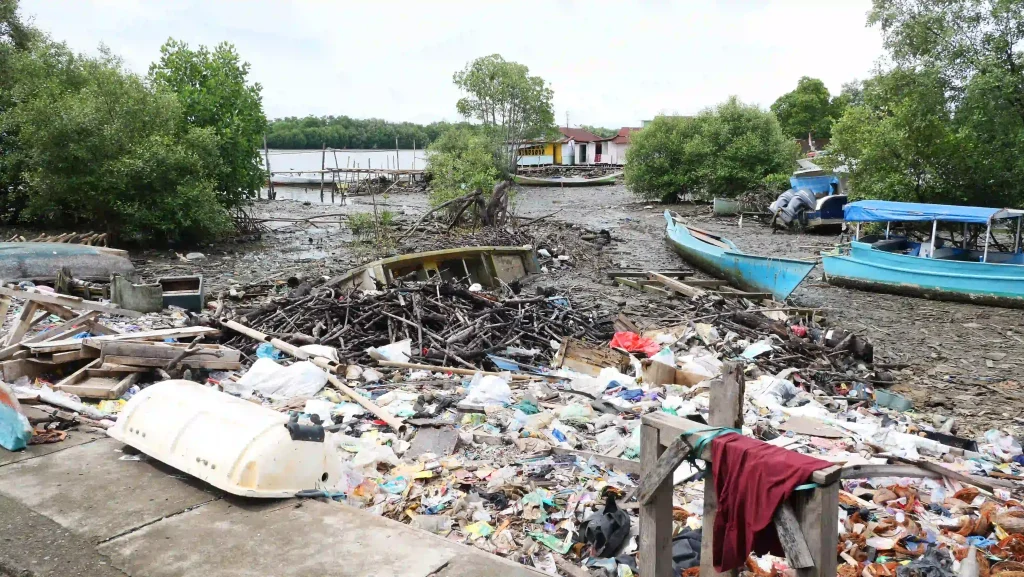
… these floods are a clear manifestation of the ecological and spatial justice crisis driven by business and political interests.
Jakarta, December 3, 2025 — The Tifa Foundation expresses its deepest condolences for the flash floods and landslides that have struck the provinces of Aceh, North Sumatra (Sumut), and West Sumatra (Sumbar), which have claimed hundreds of lives and caused immeasurable ecological and economic damage. “This tragedy is an ecological disaster resulting from a combination of the climate crisis and local-level environmental degradation,” said Firdaus Cahyadi, Program Officer for Natural Resources and Climate Justice at the Tifa Foundation. “This ecological disaster stems from national policies that have created an exploitative environmental governance system.”
The Tifa Foundation, continued Firdaus Cahyadi, views these floods as a clear manifestation of the ecological and spatial justice crisis driven by business and political interests. The ecological disasters in Aceh, North Sumatra, and West Sumatra demonstrate a strong correlation between the increased frequency and intensity of flooding and massive deforestation in the upper reaches of Sumatra’s river basins,
“Permits issued for the forestry, mining, and large-scale plantation expansion sectors have destroyed natural ecological barriers, eliminating the forest’s role as a water absorber and retainer,” he emphasized .
“This is a matter of flawed spatial planning.” According to Firdaus Cahyadi, spatial planning policies that prioritize land conversion and extractive investments in disaster-prone or protected areas have created structural vulnerabilities for communities living in downstream regions. “This is evidence of the state’s failure to fulfill its constitutional mandate to ensure a good and healthy environment,” he explained.
On the other hand, Zico Mulia, Program Officer for Human Rights and Democracy, stated that the ecological disasters in Aceh, North Sumatra, and West Sumatra constitute human rights violations. “The loss of lives and the loss of homes are also due to environmental damage facilitated by the state, which constitutes a violation of human rights,” he explained. “The rights of the people are clearly violated when state policies destroy the environmental ecosystem that sustains life, ultimately resulting in the loss of lives, the destruction of healthy livelihoods and the environment, and the loss of people’s homes.” Specifically regarding Aceh, which recently marked the 20th anniversary of peace following the peace agreement with the signing of the Helsinki MoU in August 2005. The Tifa Foundation, which supports the work of the Aceh Truth and Reconciliation Commission and civil society organizations in Aceh, has produced a report on findings and recommendations for the rehabilitation of victims of severe human rights violations during the conflict. “There are more than 5,000 victims and family members from 14 districts who have testified during the 2018–2021 period and have been recommended to receive restitution from the state, yet they have now lost family members and relatives due to disasters and environmental damage.”
Furthermore, Zico Mulia added that disaster victims are not only entitled to emergency aid but also to recovery and justice resulting from state policies and negligence regarding the actions of groups or corporations that damage the environment through illegal logging and land conversion for their own interests, thereby violating the rights to health, food, housing, education, and decent work and livelihoods for the surrounding communities. “Victims of ecological disasters are also entitled to comprehensiveremedies—economic, social, and cultural,” he added.
“Victims are also entitled to justice through the enforcement of the law against corporations or officials found to have been negligent or involved in environmental destruction.”
In this regard, according to Firdaus Cahyadi, the Tifa Foundation is urging the central and local governments to immediately conduct a comprehensive environmental audit and review of permits for all concessions located within the watershed and upstream areas. “Immediately impose a permanent moratorium on new permits and revoke those proven to be the cause of ecological damage,” he explained. “Furthermore, law enforcement agencies must pursue transparent and firm legal action against corporations and/or officials responsible for deforestation and environmental damage that lead to disasters.”
Meanwhile, from a human rights perspective, Zico Mulia stated that both the central and local governments must take into account the aspirations and needs of disaster victims when responding to disasters. “Ensure the comprehensive and fair fulfillment of victims’ basic rights, including food, healthcare, adequate temporary housing, education for children, and psychosocial support, in accordance with the Constitution and the 1945 Constitution, as well as national and international human rights instruments,” he said. “Additionally, involve the participation of victims, local communities, and civil society organizations in the planning process for rehabilitation and reconstruction.” Human rights violations by the state—whether through policy or neglect—that result in environmental damage have occurred on a massive scale and continue to recur. The importance of efforts to uphold justice and reveal the truth transparently will end impunity, restore victims’ rights, and prevent recurrence in the future. The Tifa Foundation assesses that this disaster is a message that nature has reached the limits of its resilience.
“The government must stop acting as a facilitator for those who destroy the environment and immediately return to the constitutional path,” concluded Firdaus Cahyadi.
The Tifa Foundation was born out of the reform movement with a vision of realizing an open society in Indonesia, beginning on December 8, 2000. Through three strategic issue areas—Human Rights and Democracy, Natural Resources and Climate Justice, and Data Policy and Governance—Tifa works to ensure that civil society remains open, diverse, equitable, and just. Programs include Safe Journalism, transitional justice, a protection network for human rights and environmental activists, energy transition justice, digital democracy, and civil society digital resilience.
Media Contacts:
Firdaus Cahyadi – Program Officer, Natural Resources and Climate Justice ([email protected])
Zico Mulia – Program Officer, Human Rights and Democracy ([email protected])
Communication & Campaign Officer ([email protected])