
Press Release: Rising Trend of Violence Against Journalists: Journalists from Central Java and Yogyakarta Announce the Formation of the KKJ
As we enter 2025, the trend of violence has risen sharply. At least 21 cases have been recorded in Central Java, including intimidation by military personnel against journalists covering land conflicts in Pundenrejo, physical violence against reporters while covering the National Police Chief’s activities at Tawang Station in Semarang, the arrest and beating of student journalists while covering International Workers’ Day (May Day), the seizure of cameras, and doxing of AJI Semarang members and media workers in Central Java.
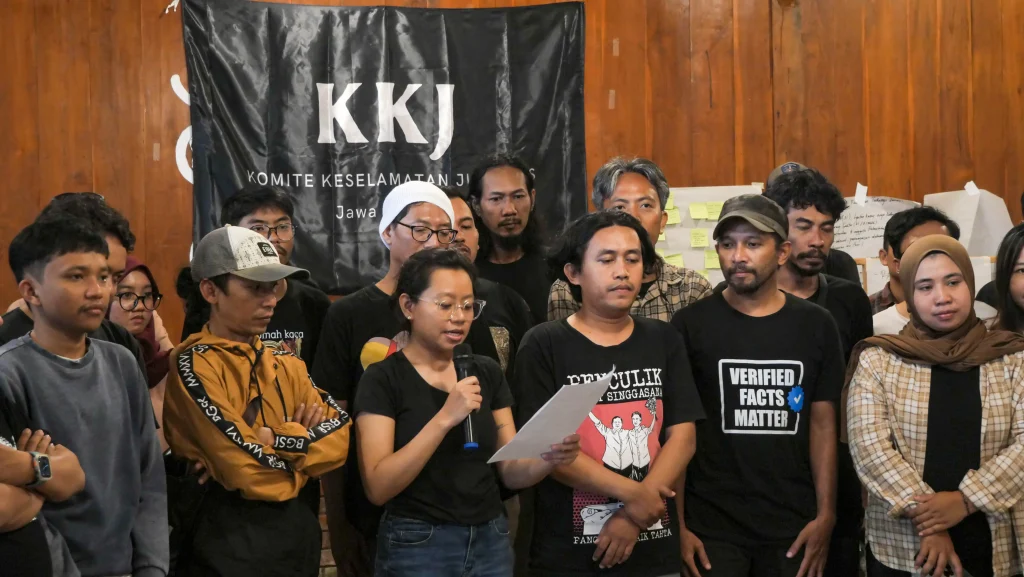
Semarang, February 22, 2026 — A number of professional journalism organizations, civil society networks, and student press groups formed the Central Java-Yogyakarta Journalists’ Safety Committee (KKJ) on Sunday (February 22, 2026). The formation of the KKJ was urgent, given the rising number of incidents of violence against journalists under the Prabowo-Gibran administration.
The group of journalists included representatives from AJI Semarang, AJI Solo, AJI Purwokerto, and AJI Yogyakarta; the professional organizations Pewarta Foto Indonesia (PFI) Semarang and PFI Solo; civil society networks such as SPLM Central Java, LBH Semarang, and LRC-KJHAM; as well as student press organizations.
AJI Indonesia reports that violence against journalists escalated throughout 2025, with 89 cases of violence against journalists recorded. It is believed that many victims still go unreported. This escalation indicates that the safety of journalists under this regime is more precarious and highly vulnerable. In contrast, over the previous three-year period, the number of cases fluctuated. In 2024, there were 73 cases of violence against journalists, and in 2023, there were 86 cases. Meanwhile, in 2022, there were 60 cases.
Aris Mulyawan, Chair of AJI Semarang, said that the establishment of the Central Java-DIY Journalists’ Safety Committee (KKJ) will ultimately be tasked with protecting journalistic work. The KKJ is the starting point for ensuring journalists’ safety. Journalists’ safety is a key prerequisite for the upholding of democracy. Without guarantees of safety, press freedom will remain nothing more than a meaningless slogan.
“This is our starting point for building a safety ecosystem for journalists in Central Java and the Yogyakarta Special Region. According to our records, there are about 23 journalists from Central Java who have been victims, some of whom are student colleagues. Ten members of the Student Press Association (LPM) were victims of violence during Ahmad Luthfi’s term as leader. The data shows that the majority of perpetrators of violence are police officers and members of the Indonesian National Armed Forces (TNI),” said Aris on Saturday, February 21, 2026.
As we enter 2025, the trend of violence has risen sharply. At least 21 cases have been recorded in Central Java, including intimidation by military personnel against journalists covering land conflicts in Pundenrejo, physical violence against reporters while covering the National Police Chief’s activities at Tawang Station in Semarang, the arrest and beating of student press journalists while covering International Workers’ Day (May Day), the seizure of cameras, and doxing against members of the Semarang chapter of the Alliance of Independent Journalists (AJI) and media workers in Central Java. The majority of violence victims in Central Java also come from the student press community.
Raditya Mahendra Yasa, Chair of the Indonesian Photojournalists Association (PFI) in Semarang, said that the formation of the Central Java-Yogyakarta Journalists’ Coalition is currently a matter of great urgency. He said it is crucial to identify instances of violence against journalists. This is especially true given that violence has, in fact, become normalized even among journalists themselves.
“This is an urgent matter for the safety of journalists under the current regime. In fact, this has been urgently needed for a long time. If violence occurs, we must be prepared to take appropriate measures. Photojournalists are also particularly vulnerable to violence,” he said.
Meanwhile, Erick Tanjung, Coordinator of KKJ Indonesia, said that the Prabowo-Gibran regime is cloaked in narratives of “anti-hoax,” “national security,” or the protection of public morality. A climate of fear has been created, and social control has become increasingly widespread. This is compounded by significant budget cuts at the Press Council, which have resulted in numerous cases being stalled.
“In 2025, there were 1,116 complaints filed with the Press Council. With that many complaints and the budget being cut, there is a risk that they won’t be resolved this year. Fifty-eight percent of the budget has been cut, leaving funds only for staff salaries. There isn’t even funding left for competency testing. This is a pretty dire situation under the Prabowo-Gibran administration,” he said.
He noted that it is currently important to create a safe media ecosystem so that cases involving journalists can be fully resolved in court. This is because, until now, many cases of violence against journalists have stalled at the police investigation stage.
Miftah Faridl, Head of Advocacy at AJI Indonesia, emphasized the importance of advocacy for journalists as a form of persuasion that involves raising awareness, rationalizing, presenting arguments, and making recommendations on a particular issue. AJI Indonesia itself carries out advocacy work through its Safety Corner program, which provides comprehensive information on safety and support for journalists.
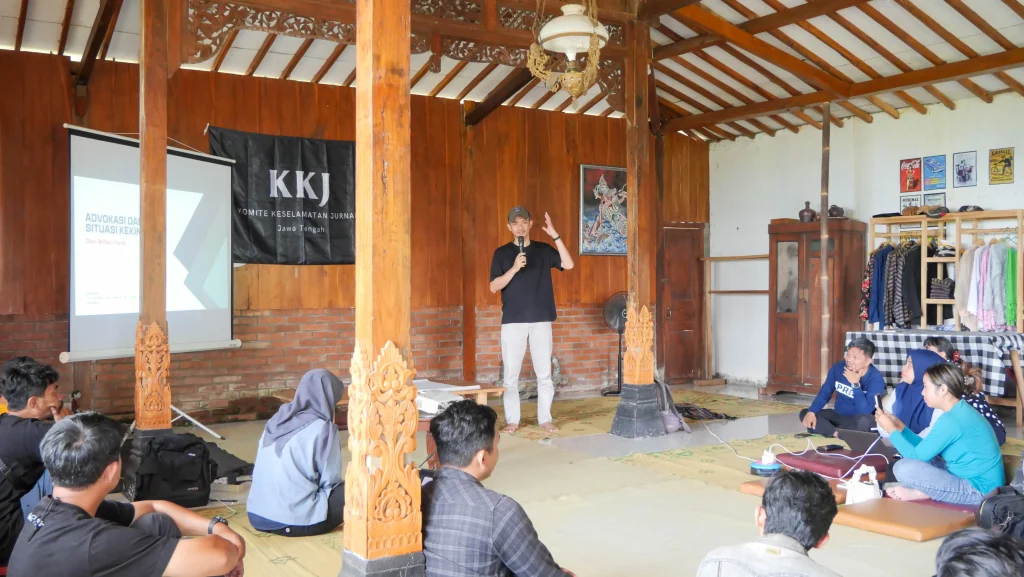
“Supporting victims is crucial to ensuring they receive the justice they are fighting for. With the declaration of the Central Java and Yogyakarta Journalists’ Solidarity Network, we hope it will serve as a safe and comfortable space for victims in their struggle. This declaration also marks the beginning of a collective, cross-organizational movement to advocate against violence against journalists,” he explained.
This event was supported by the Tifa Foundation’s Safe Journalism program. In her opening remarks, Arie Mega, the Tifa Foundation’s Project Officer for Safe Journalism, noted that this Journalist Safety Training is crucial given the high incidence of violence against journalists in Central Java and the Special Region of Yogyakarta.
“Thanks to our shared commitment, today’s event was finally able to take place. Central Java and Yogyakarta are not doing well, especially since we have just launched Journalist Safety Index. In addition to the fact that violence rates remain high, it appears that many of our colleagues are engaging in self-censorship due to fear and intimidation self-censoring , particularly regarding issues like MBG and PSN. And here, the number of PSN cases is also quite high,” said Arie.
According to him, violence against journalists not only affects their work but also leads to a decline in the quality of democracy in Indonesia. Furthermore, the public is unable to exercise its right to information.
“Safe Journalism hopes that through this shared commitment, journalists won’t be left to bear the burden alone when faced with intimidation and reporting issues, but that other NGO partners, such as LBH, will also be involved. Safe Journalism is here to support our colleagues, so we support collective journalism,” he said.
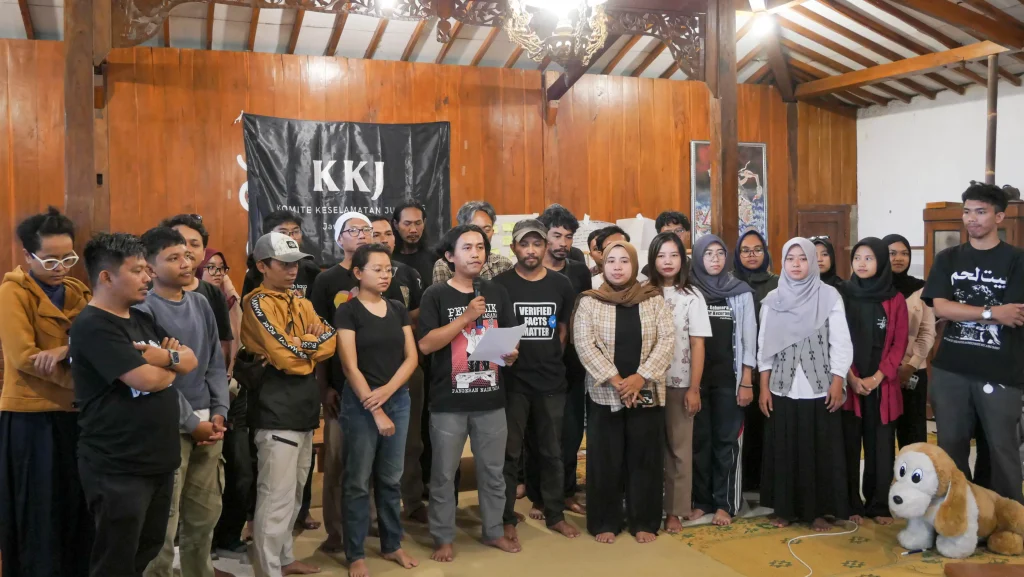
Safe Journalism is a program initiated by a consortium comprising the Tifa Foundation, PPMN, and HRWG. It is supported by the Embassy of the Kingdom of the Netherlands. The program aims to create a safe and equitable ecosystem for journalists and media organizations.
As of 2026, Safe Journalism has facilitated the establishment of 4 (four) of the 11 Journalist Safety Committees in Indonesia: the Aceh Journalist Safety Committee, the Central Sulawesi Journalist Safety Committee, the Southeast Sulawesi Journalist Safety Committee, and most recently, the Central Java – Special Region of Yogyakarta Journalist Safety Committee.
This program provides an integrated portal for complaints, assistance, and learning at JurnalismeAman.com that is accessible to the public.
Contact:
| Arie Mega [email protected] Project Officer at the Tifa Foundation for Safe Journalism |
[email protected] Communications Officer, Tifa Foundation |